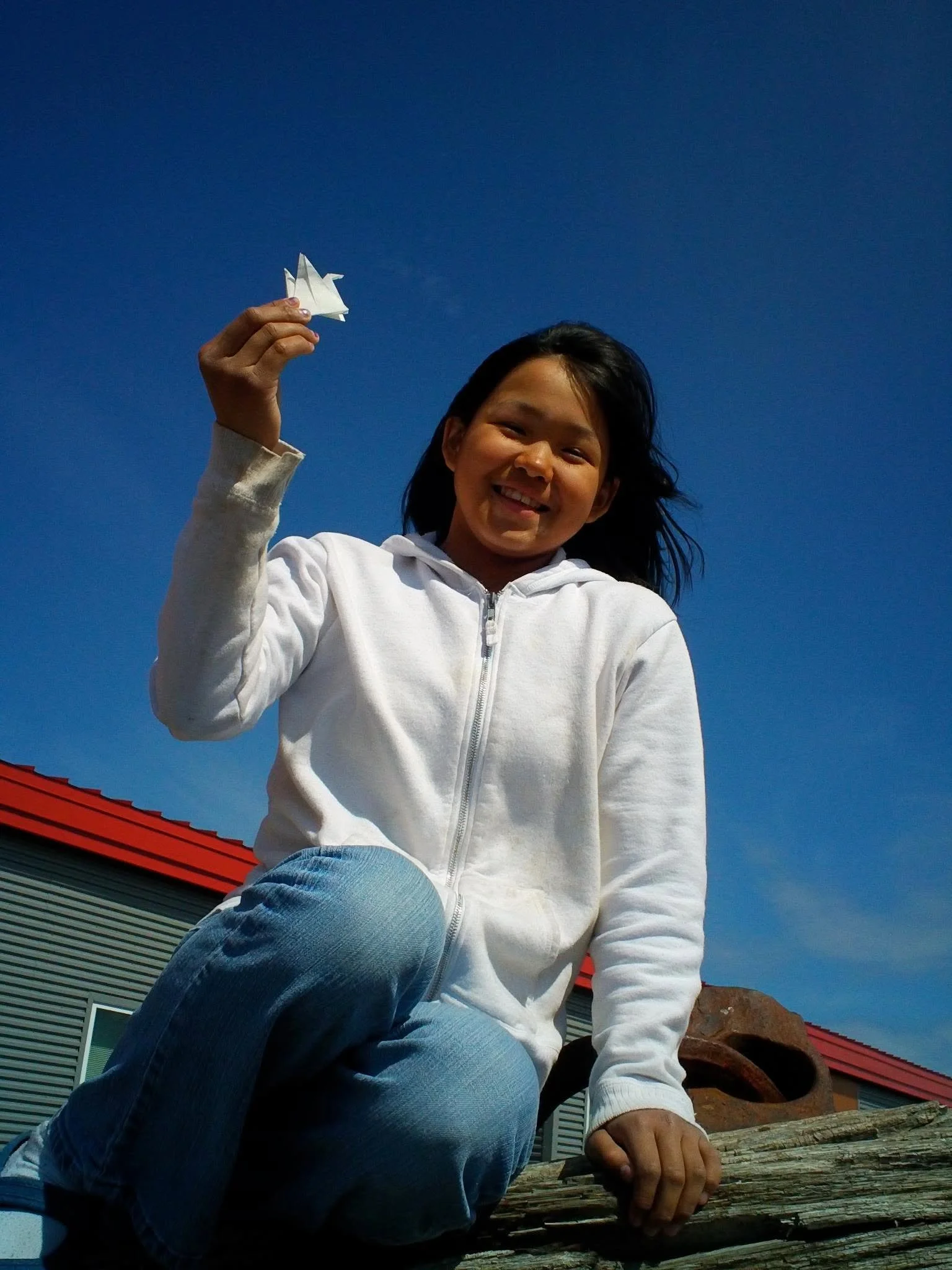
2012 Reboot: Fighting suicide, one fold of paper at a time
From The Anchorage Press
Posted: Thursday, August 23, 2012 1:56 pm | Updated: 2:59 pm, Thu Aug 23, 2012.
Matthew Caprioli
Choreographer Leslie Kimiko Ward’s first performance piece may be one of the most intriguing philosophy seminars out there, full of origami lessons, seaweed kelp impersonations, powerful photographs and thought-provoking questions.
The story has resonated around the world: a dance teacher travels to a remote Alaskan village, witnesses a death that shakes the tight-knit community, encourages her class to make 1,000 paper cranes, which ultimately gives her students something peaceful to do and encourages the town to find joy in each other during a hard time.
The full-length script developed from Under 30, a projected hosted by the Out North Contemporary Art House, where artists can dabble in arts outside their genre. Ward is a choreographer, and while dancing plays a role here, most of its power comes from the interplay of a live camera, a large screen projecting her movements, and Ward’s acting.
Ward said she chose this arrangement because it seemed like the best fit for the message she wanted to convey about contemporary communication—namely, that it can be very difficult to feel connected to anything in the incessant and unstable images social media offers.
“I gave myself great permission to use whatever medium made sense,” Ward said in an interview. “I didn’t want to censor myself. (The choice of medium) didn’t seem like reason to put in an arbitrary barrier to how to address the message.”
It quickly became clear that video blogging was the best way to tell about her stay in Saint Michael. It provided continuity, authenticity, and a surprising amount of humor for a story whose epicenter is death and suicide.
Ward said she aims to serve the community and individuals rather than adhere to arbitrary standards of “good art.”
Most art nowadays claims some social function. Ward’s is perhaps rare in that the social function came first, then the art.
“Community is what inspired the idea in the first place,” Ward said.
Indeed Ward is a here and now person. She said her biggest inspirations are local artists because she can know them as people first, and then on another level as artists. This includes Panwar, the band whose music accompanied the pictures and films during the performance.
Throughout the performance Ward encourages questions, like any good teacher, hoping the student (or audience member) can find the solutions to sort out their own life.
The play opens with Ward trying to check up on an anonymous caller. She tries to reach him or her through every technological medium possible—computer, phone, Facebook, texting. The person does not reply at the beginning or the end of the performance. She eventually texts them “I’m here if you need me.” The performance has a ton of themes, but this—I’m here if you need me—Is Ward’s real message.
Ward has lived in Alaska 10 years, and each year, she said, someone she’s been close to has committed suicide. The project and the performance of 1,000 cranes is her effort to stop that trend from continuing.
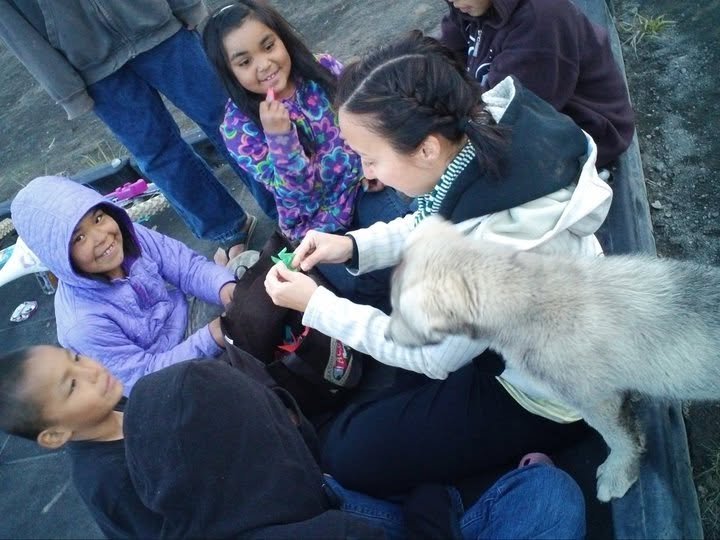
07/2026, The Lesson of 1000 Cranes
In an Alaska Native village, a young man’s tragic death brought about a global, viral, arts-based, social media, suicide-prevention initiative and taught me the importance of showing up as a human first. 15 years later, I’ve put this knowledge to work in my classes and it has profoundly changed the way I teach. When I first started in the classroom, I cried in my car every day after school, exhausted, defeated, feeling like I was failing all of the children. Then I remembered,
Show up as a human first.
It didn’t matter what was on my job description. It didn’t matter what anyone was expecting me to do. What mattered was that I was showing up and being with people in a deep and authentic way. That was the bulk of the work. The rest was having a clear sense of the vision of our ideal learning space and path to understanding. Teaching became less about standing and yapping and more about guiding and exploring. I still use these hard-won skills in my classrooms today. They are the key to turning my workplaces into joy factories, accelerating learning for my students, and helping everyone look forward to coming to school everyday.

07/2026, Submitted Proposals to SXSW and Innovative Schools
Well, I'm officially too big for my britches. I woke up with a glut of audacity this past week and I've pitched workshop proposals to both the Innovative Schools Summit and SXSW EDU. I've also finished the outline of the 1000 Cranes for Education book that will be coming out this fall.
The primary message of the book, and the ongoing legacy of 1000 Cranes, is that by centering humanity, we rebalance systems. The book has practical, teacher-created, student-tested, easy-to-implement strategies and tools to center humanity and accelerate learning and compound joy.
The workshop is called "Centering Humanity to Rebalance Education." Here's the pitch:
Education is at an inflection point. As AI reshapes learning, teacher burnout rises, behaviors reach a tipping point, and student needs grow more complex, our current path is incompatible with survival. Yet with the right mindset, educators can walk directly into the fray with joy, wonder, and the power of transformation. This workshop delivers teacher-created, teacher-tested, high-yield strategies that lighten teachers' load, give kids more of what they need and restore the magic of learning.
Takeaway #1: Building community through curiosity: Questions and Tasks that set the stage for learning
Takeaway #2: Don’t be a garbage human: Sparking intrinsic motivation and collaborative learning by being a better neighbor
Takeaway #3: Creativity for differentiation: Step-by-step guide for unleashing creativity in the classroom to boost access and accelerate learning
I'll keep you all posted on whether the proposals get picked up.

07/2026, 1000 Cranes turns 15!
Wow! What a milestone.
15 years ago, as I lay awake feeling lost and afraid, curled in my sleeping bag, tucked under a teacher's desk in a darkened village school, I could never have imagined we would be here.
For those of you new to our story, 15 years ago, in a tiny, remote, Indigenous village by the Bering Sea, a young man's traumatic death inspired the folding of 1000 origami cranes and launched a global wave of social media support. Through the 1000 Cranes for Alaska campaign, the simple act of folding an origami crane and posting your picture became synonymous with "I see you and I stand with you." Thanks to all those who participated; together we were able to bring hope and healing to a grieving community, raise awareness around suicide prevention, and demonstrate the transformational power of arts engagement.
Today, 1000 Cranes has grown and softened in many ways. Reflecting back on the past 15 years, I'm amazed at how many twists and turns our story has taken. From folding those first few cranes out of butcher paper cut with safety scissors to becoming a global suicide prevention campaign, our story hit the ground running. We have seen our story told as a news outro, a dinner party anecdote, a one-woman-show, a keynote speech, a memoir. And the best part? Our story is far from over.
Next year will see the newest chapter of our story take flight: 1000 Cranes for Education, a digital resource hub helping educators and families center creativity, culture, and movement to improve learning and increase joy.
In this new venture, I will be sharing the many lessons I have learned during the past 15 years of the 1000 Cranes experience. Through this resource, I'll be providing tools and strategies to educators, parents, administrators, and those with a vested interest in educating our young people. These tools and strategies help educators rebalance student behaviors, improve academic outcomes, strengthen relationships with students and families while increasing the capacity and opportunities for joy. For sneak previews at some of the topics, take a peek at my work on the socials.
I'm beyond excited at this newest development of 1000 Cranes and am looking forward to sharing our continued progress with you all.

2013 Reboot: Farming and Writing, Writing and Farming
It All Begins Here
Nine months since my last entry. I just did the math and smiled when I realized the significance. This period of my life has felt uncannily gestational, a re-birth in the making.
Nine months ago, I was leaving Alaska, a tiny cargo trailer full of my grandparents' heirloom furniture hitched to the back of my Jeep Liberty, my cat in the front seat, the two of us bound for a modest, green parcel of farmland in the Willamette Valley of Oregon.
The long ride, first on the Matanuska ferry, then across the Prince Rupert Highway, through Canada at the height of the fall, past miles of brightly painted hillsides and through tapering amber sunsets, gave me the time and space I needed to steep in all the bittersweet feelings I had about moving away.
Here are a few photos I snapped on the journey...
Arriving at my family's farmhouse in Oregon, I unpacked my few bags and set a mattress out on the floor. I felt like a wayward divorcee, nervous, emotionally spent, fragile as a weathered bone.
But as fall turned to winter, and winter to spring, as I bucked hay to feed the sheep, nurtured seedlings in the greenhouse, and carried yet another damp, wriggling, newborn lamb into a stall to bond with its mother, I felt myself beginning to thaw, the hard spots in me giving way like calving glaciers.
Fast forward nine months, and I have just past the hundred-page milestone of a book I never thought I'd write, I'm up to my eyeballs in juicy red strawberries, and I finally realized that I like it here enough to hang some curtains in my bedroom and raise my mattress off the floor.
Though still very much a work in progress, I also feel ready to share this process of living on the farm and writing a book, originally inspired by the experiences that launched 1000 Cranes, a social movement of suicide prevention, and my two year journey from a remote native village on the Bering Strait of Alaska to a 40 acre farmstead in rural Oregon. With editing feedback from my mentor, novelist Jo-Ann Mapson, I have begun to re-trace my life's touchstones, collecting them, like paper cranes, into a developing memoir, excerpts of which I plan to share with you here, along with updates from my new life out on the farm.
While the things you read on this blog may eventually find their way to the editing room floor, especially as this book continues to undergo the surprisingly organic process of growing and sloughing, I hope you find something of value in the parade of words, however ephemeral.
Please feel free to join me by adding your comments, suggestions, and perhaps even some of your own memories to the conversation. A walk down memory lane is wonderful, but never quite as nice as sharing a walk with a friend.
2012 Reboot: Post Show, Heading South
It All Begins Here
Sunday, August 19th was the first day in over five months that I rested from the creation of this latest performance work. Three performances had already gone by when I took my first few tentative steps back into the rest of the world.
I remember feeling as though I'd wandered into a crowded airport, clad in a drafty hospital gown. This project has consumed me like none other, and I think a new equilibrium is still some ways off.
So much has happened so quickly, and though the dust is still settling, I'll share some of the highlights from the roller coaster of the past few weeks, and let you know what's next on the horizon for this project.
The newest show, "1000 Cranes", opened and ran for two weekends. We had interviews, press articles, sold out houses, standing ovations, and after each performance Tami and I held a talking circle for anyone who wanted to stay. I think Tami would agree that these talking circles felt like the true gift of the work. Strangers from all walks of life opened their hearts to one another night after night, holding profound and sacred space for speaking deep truths, taking turns both witnessing and being witnessed.
The connective effect of this work is hard to ignore, and one of my favorite moments came after closing night, when a small, exhausted group of our production team gathered in Out North's gallery space, and amid peals of unencumbered laughter, we folded cranes, ate spam musubi (thanks Flash!), and shared a champagne toast. Some smiles seem more real than others, and these were some of my favorites of the summer.
Saturday, August 25th marked the end of the run, and in the shower Sunday morning, I had the following thought: "I think I want to turn this story into a book." An interviewer from First Alaskans Magazine (feature article coming in December) led me to a grant opportunity with the Alaska Humanities Forum, and I immediately began working on the application. Jo-Ann Mapson, prolific novelist and my fiction professor/advisor from my MFA days, has come on board as a mentor/editor for the new project.
Today, Thursday, September 13, I am aboard a ferry bound for Juneau as part of my long journey "home" to the family farmstead in Oregon. I feel somewhat numb to the experience of leaving Alaska.
I've re-read the words I wrote on the flight home from St. Michael when it felt as though I was "leaving my heart behind." This thought still rings true, although now I don't believe it is my heart itself that lingers, but rather an impression, a damp cast in warm soft sand, a groove where my heart has nestled and could again, should we ever come back this way. These spots, they're stored in my heart like the sense memories of really good hugs.
Writing this I realize I've been doing this my whole life, unconsciously wielding my heart like a stamp on a busy tourist's passport. Today marks a true turning point, where I begin to retrace my steps, deepening a second journey with perspective, sweetening it with nostalgia, looking forward to once again pressing my heart into those same spots, wondering what will be unlocked.